


This structure is not just to keep things neat, but it also affects how a law firm runs. According to ABA’s 2024 Profile of the Legal Profession, there are over 1.3 million lawyers in the USA working across more than 450,000 law firms of all sizes. How a law firm is structured really matters. It affects how quickly cases move, how decisions are made, and whether talent is retained or not.
In this guide, we will go through the complete law firm hierarchy from top to bottom, law firm structure types, and how they differ from each other.
What Is Law Firm Hierarchy
Law firm hierarchy is simply the way a law firm works. It refers to the structured system of roles and authority levels that organizes every legal role in a law firm from senior leadership to entry-level support staff.
There are three core functions that the law firm hierarchy serves.
Decision-making clarity: Law firm hierarchy defines who has the authority to approve major decisions, accept clients, and set compensation.
Career pathway: Every associate who joins the law firm can clearly see progression from the first year to becoming a partner.
Operational efficiency: Hierarchy improves how firms work day by day. When reporting lines are clear, there is less confusion. It avoids repetition in legal work, dropped tasks, and management failures. It helps law firms avoid mistakes that can cost clients and money.
While many law firms use a traditional pyramid hierarchy, they set up their teams in different and more planned ways than before. Understanding the hierarchy starts with the roles at each level.
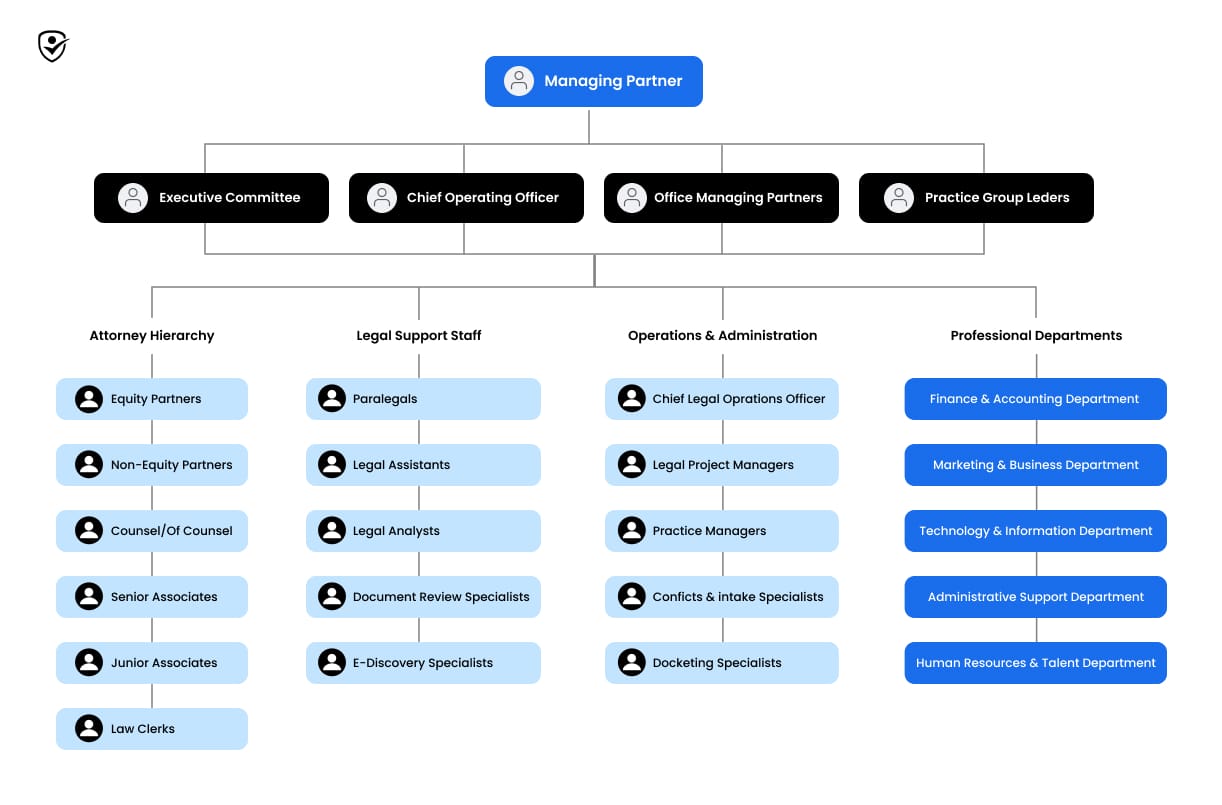
The Law Firm Hierarchy Structure & Chart
Here is the complete breakdown of the law firm’s organizational chart and hierarchy of a law firm.
Tier 1: Law firm leadership
Managing partner
Managing partner oversees all firm operations, sets strategic directions, manages partner relationships, and represents the firm. They act as chief executive officers in a law firm. Their core duties are managing operations, financial health, and cultivating long-term relationships with clients.
Salary/Compensation: Managing partners at big law firms can earn $2M–$5M+ annually, including profit distributions. While at mid-sized law firms, they can earn $500K–$1.5M yearly.
Career note: Equity partners who have more experience in the field elect managing partners for a fixed duration.
Equity partner
Equity partners hold the shares of a law firm. They have a financial interest in law firms because they get a profit share along with a fixed salary. Additionally, they are involved in management and decision-making, and sometimes they may have a say in the strategic directions of the law practice.
Compensation: The compensation of equity partners is variable and often tied to firm profitability. Non-equity partners can earn $500K–$750K (fixed). While equity partners working at top firms can earn $1M–$5M+.
Career note: To be an equity partner of law firms, it takes 7-10 years at BigLaw firms, while 5-7 years at mid-size firms.
Non-equity partner (income partner)
A non-equity partner, often called an income partner, is a senior-level attorney who is given the title of partner but with a specific distinction. They hold partner titles but do not own shares of the firms. They receive a fixed salary rather than profit distributions and have less governance authority than equity partners.
Compensation: Non-equity partners can earn $500K–$750K at large firms.
Career note: This role can serve as a stepping stone to equity or remain a permanent career track. It depends on the compensation model of the firm.
Of counsel
Assign document ownership to a specific person, not to the whole team. That person is responsible for maintaining and keeping this document up to date. If there is any confusion regarding which version is correct, the owner is answerable.
This is important for legal records management and increases law firm productivity because bars can ask the owner’s name. To make this process smoother, each document should have a clear record of ownership, including a main owner and one on backup.
Tier 2: Associate attorneys
Senior Associate (Years 5–8)
Senior associates manage complex matters with limited supervision; they contribute more towards protecting billable hours. They develop client relationships and sometimes supervise junior associates. At this stage, an associate is evaluated for promotion or partnering opportunities based on performance and career goals.
Salary (large firm): An associate attorney’s base salary is $390,000–$435,000 at the Cravath scale 2025). Mid-size law firm associates can earn $180,000–$280,000.
Career note: This is the point where firms decide on the partnership track. Firms using ‘up-or-out’ policies evaluate senior associates for promotion or counsel them to leave. Understanding lawyers’ work hours at this stage is crucial.
Mid-Level Associate (Years 3–5)
They are in a sweet spot in their career, having stronger skills and less supervision than juniors. Mid-level associates start specializing in a practice area. Additionally, they take more responsibility for research, drafting, and client communication.
Salary: Mid-level associates at a large law firm earn around $295,000–$360,000 base. While at a mid-size firm, it can range between $130,000–$200,000.
Career note: It’s the highest attrition period, and at this stage, mid-level associates have the highest burnout rate. Many move in-house or to smaller firms at this stage.First-Year / Junior Associate
An entry-level attorney role, typically for a recent law school graduate. Handles research, document review, drafting, and deposition support under supervision. Heavy billable hour pressure from day one.
Salary (large firm first-year, 2025): Base salary of junior associates is $225,000. At mid-sized law firms, they can earn $115,000–$180,000.
Government: Junior associates can make $75,000–$110,000 annually at government law practices.
Career note: This is the time when the partnership track timeline effectively begins. In large firms, the billable targets are typically 1,900–2,100 hours/year.Staff Attorney / Contract Attorney
A staff attorney or a contract attorney is a full-time lawyer who does not follow a partnership track. They have stable hours and lower pay as compared to other types of attorneys. Staff attorneys review documents, compliance, and high-volume legal work.
Law Clerk / Summer Associate
They are not full employees, they are interns or work temporarily. Summer associates at larger firms often earn up to $3,800 per week. They often work in courts to gain experience for their long-term career goals.
Tier 3: Paralegals, Legal Assistants & Support Staff
Paralegals
Paralegals assist attorneys with document drafting, legal research, and file management. Many law firms have both onsite and a virtual paralegal assistant for legal advice or to represent clients, and must work under a lawyer’s supervision.
Because they manage a high volume of case files, legal document management is an essential skill and a key part of their role.
Salary: The national average salary of paralegals is $60,680/year. Paralegals at large law firms can earn $80,000–$102,750 yearly. While specialized paralegals (IP, real estate) can get premium compensation.Distinction: Unlike the legal intake specialist, who works pre-acceptance, paralegals work on active case support. The role of a paralegal starts when a case is accepted, and they focus on active case management.
Legal Assistant
Legal assistants provide crucial administrative support in law firms. Following a more flexible model, firms are seeing the value of dedicating workload to a virtual legal assistant more now to handle scheduling, correspondence, filing, and document formatting. They also manage e-filing systems, client portals, and billing software.
Salary: Most of the on-site legal assistants get compensation from $45,000–$75,000 nationally. While Senior legal secretaries at large firms earn more than them.
Legal Assistant
A law firm administrator manages non-legal operations. They manage vendor relationships, HR, facilities, and financial administration. Additionally, they implement office policies and manage inventory.
Salary: Their compensation range is $70,000–$150,000+.
Types of Law Firm Structure
Solo practitioner
A solo practitioner owns and runs an entire law firm. They may employ staff such as paralegals, legal assistants, or administrative staff, but they don’t have hierarchy partnership. The attorney handles everything from legal work to bringing in clients.
Who it suits: Lawyers who have strong client bases in a single practice area, such as family law or immigration, are suitable to run a law firm. According to BCG 2025, solo practitioners can earn up to $250,000+ annually.
Structural note: There is no organizational chart in the traditional sense; the lawyers sit at the top and oversee all support staff. The biggest structural challenge here is having no succession plan if the lawyer steps away.
Traditional partnership
In this law firm structure, equity partners are the owners of the firm and share profits. Associates follow a clear path to become a partner. The hierarchy starts from partners to junior associates.
Who it suits: Well-established private law firms of any size are ideal choices. This is still considered a dominant model among Am Law 200 firms.
Structural note: Decision-making authority rests with equity partners. Non-equity partners and associates operate within the hierarchy they did not create.
Limited liability partnership
This is similar to a traditional partnership, but partners have limited personal liability for firm debts and actions of other partners. Their structure is identical to traditional partnerships, but partners get important legal protection from personal liability.
Structural note: LLP is a legal classification, not a structural model. The internal hierarchy is the same as traditional; the only difference is in liability exposure, not the organization’s chart design.
Professional corporation (PC)
Attorneys become shareholders instead of partners. Shareholders elect a board that governs the firm. This structure is less common but is used in states where LLPs are not available for law firms.
Structural note: In a corporate structure, a board sits above the managing attorney, which makes decision-making more layered and slightly complex.
Boutique law firm
This is a small but highly specialized firm that focuses only on one or two practice areas (M&A, IP litigation, employment law), thus improving the law firm’s productivity in the long run. These firms have 2-20 professionals and hire highly professional attorneys.
Who it suits: Specialist attorneys who focus on a specific area and serve clients who pay more for deep expertise rather than general services.
Salary note: In high-demand areas, partners in boutique firms can earn 20–45% more than those in similar-sized general practice firms.
Large Firm
Large firms have 100+ attorneys, multiple offices, and numerous practice areas. They have a complex law firm structure with different partner tiers, practice group heads, and support departments for large businesses.
Structural note: Large law firms use a lockstep compensation model, where salary is given on the basis of seniority level. Salary of first-year associates typically ranges from $225,000 annually.
The right structure of your law firm depends on the practice area, size of firms and type of careers you want to offer your attorneys.
Business Support Departments in Law Firms’ Organizational Structure
Business support departments sit at the foundation of law firms. They don’t handle legal cases directly, but they ensure the smooth working of the whole firm. These teams report to the firm administrator, COO, or managing partner.
Finance & accounting
The finance and accounting department manages billing, collections, payroll, and budget planning. Finance directors can earn $150,000–$250,000.
Marketing & business development
The marketing & development department supports client acquisition, manages the firm’s brand, digital presence, and tracks competitive intelligence. This department is growing as most law firms have been hiring for digital marketing and content roles since 2020.
Human resources & talent
The human resource & talent department handles recruitment, onboarding, performance reviews, and associate development programs. HR has become more important as law firms compete to hire and retain skilled associates in a limited talent pool.
Information technology
The information technology department manages software infrastructure, cybersecurity, e-discovery tools, and document review platforms of law firms. IT has shifted from a support function to how law firms operate and compete.
Administrative Operations
They handle daily operations like reception, facilities, document management, and mail services, reducing administrative burden in law firm. Firm administrators or the COO manage them to ensure operations run smoothly. These departments sit at the base of the organizational chart but support everything the firm does.
Remote and Hybrid Law Firm Structures
Remote and hybrid work arrangements are becoming very common in modern law firms. According to the American Bar Association, 87% of law firms now allow lawyers to work at least part of the time.
This shift requires firms to adjust their structure to support remote teams. Virtual paralegals, remote legal assistants, and cloud-based document management systems are now key parts of modern law practices. Firms that adopt flexible work models are better at attracting and retaining talent.
Build an Effective Legal Team
Understanding law firm hierarchy is not just an abstract exercise; this is the foundation of every hiring decision, compensation, promotion, and daily management. Whether you are a solo practitioner, associate attorney, or mid-level attorney, the principles are the same for everyone: clear roles, clear expectations, and a clear path for growth.
The most effective law firm organizational structures today combine the clarity of the traditional hierarchy with flexibility. They also accommodate staff attorneys, of counsel arrangements, virtual support staff, and non-linear career paths. Today, a remote staffing company for law firms and attorneys provides a better, flexible model, ensuring you get the right talent regardless of the practice size.
Firms that get this balance right retain better talent, bill more efficiently, and outperform peers on key profitability metrics. The right law firm structure is the one that serves your clients, supports your people, and scales with your ambitions.


