
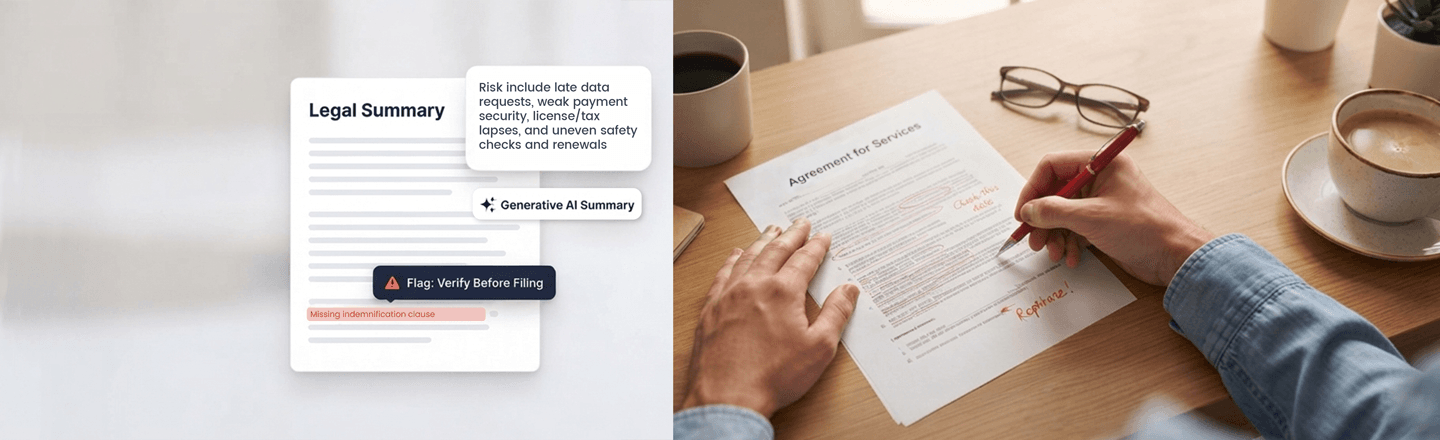

No, AI is reshaping the role of the paralegal, but it’s not taking the place of humans when it comes to the judgment and communication parts of the job.
What AI can’t do is maintain a client relationship, confirm the existence of a citation, or ensure its accuracy. AI is a tool that requires human oversight to ensure the accuracy of the legal information.
The difference is that one focuses on process, and the other on judgment.
AI can summarize documents quickly and effectively. It may not meet a deadline, contradict a detail, or be an escalation point that is needed.
This guide walks you through where AI can assist paralegals in saving time and where human intervention is still required.
Will Paralegals Be Replaced by AI? No, Here’s Why
Alone, AI cannot overtake the position of a paralegal. Here is why:
The direct answer, without the hedge
AI can summarize 500 pages of discovery documents, provide a quick search for key dates, or generate a first-pass research summary for a case quickly.
But someone is still needed to audit the AI work to ensure the summary is complete, extract required data, and that no important documents were missed.
Before worrying about AI replacing paralegals, law firms should completely understand a full breakdown of what a paralegal’s role actually covers. Ultimately, a human paralegal can flag legal mistakes that may be costly before litigation or a client’s involvement.
Why this question keeps getting a hedged answer instead
AI can take over certain tasks, but that does not mean it can handle everything a paralegal does. AI runs on the basis of patterns and information based on its training and available data. Humans manage overall case context, know how to communicate with clients in an effective way, and can exercise judgment if there is a case of escalation and inform the concerned attorneys.
According to the U.S. Bureau of Labor Statistics (BLS), the number of paralegals and legal assistants is projected to show little or no change from 2025 to 2035, and 40,800 openings are projected each year. So, paralegals are still required by law firms to perform well for their clients’ cases.
What AI Can Process and Why That Isn’t the Same as the Job
AI is effective when there is a lot of information. Problems arise when someone has to decide what that information means for a specific case.
Document review and research volume
AI can scan a large number of documents much faster than a person can. It can identify keywords in a document, summarize information, compare clauses, organize documents, and write a preliminary research summary. AI can also reduce large discovery sets to select documents that are of high value to legal teams.
This can save a lot of time for a litigation team that is processing thousands of pages. The team can then focus more on the documents that need a closer look.
Getting an answer quickly does not necessarily mean that the answer is “right” or “useful” for the case. An AI can detect a clause, or a medical record entry, but a paralegal must determine the meaning of the clause for the case, whether there’s a damages claim, and whether a document is privileged.
Why processing information isn’t doing the job
AI can process a lot of information in a short period of time. The more difficult part is knowing what those details mean in a given instance. Let’s take an example of medical record review. An AI Tool can give you provider names, dates, diagnoses, and treatment gaps within a few minutes.
However, when the report is reviewed by a paralegal, the provider’s signature may be incorrect, or there may be a discrepancy in the date of the records. Submitting documents in court with such errors can cost you legally and financially. When AI isn’t there to check the output, that’s when paralegals come in. Paralegals don’t only review the output; they also make sure the records are accurate and ready to go.
A Stanford study has evaluated AI legal research tools and determined that these can at times provide inaccurate or unsupported information. The study found that the hallucination rate varied from over 17% to over 34% depending on the tool. This is where the limitations of AI can be seen easily.
What Goes Wrong When a Firm Relies on AI Instead of a Paralegal
An organization that relies solely on AI can experience inaccuracies in cases, potential breaches of client information, and missing contextual understanding, which only a human’s judgment can fill.
Missed conflicts and compliance gaps
Conflict screening is a good example. An intake system can collect names, contact information, opposing parties, and basic case details. However, a trained legal expert may be able to see a correlation that doesn’t match a form field exactly.
A caller can mention passing a previous employer, a connection with a company, an insurer, a family member, or a previous matter. A person who is familiar with the firm’s conflict process can see that the detail warrants further investigation.
This is why firms need to understand how missed conflict of interest screening creates compliance risk. A database can find the information it is given, but someone still has to recognize when a detail deserves a closer look.
Client trust and confidentiality risk
Vendors can guarantee confidentiality, but it’s your responsibility to keep your client’s information confidential.
The ABA’s Formal Opinion 512 says lawyers need informed consent of clients before putting their confidential information into a self-learning AI tool. A typical engagement letter might be insufficient. The Opinion also notes that the information provided by one user may be used in another user’s AI input.
Therefore, don’t just rely on the words of the vendor. Ask them in detail how their data is processed, stored, and used.
Malpractice and liability exposure
There are chances AI can make serious mistakes in legal work. The case Mata v. Avianca is one example to prove this. Lawyers used a chatbot to prepare a court filing. They didn’t recheck the information, and ChatGPT created six fictional lawsuits. The court fined them $5,000 and issued a notice to inform their judges and clients.
They totally relied on AI without verifying it properly or seeking assistance from a paralegal.
The trained paralegal can cross-check the sources, identify inaccuracies, and fix them before the material is submitted to a client or court.
Why the Human Skills a Paralegal Brings Can’t Be Automated
The above examples highlight the fact that AI can assist with portions of a paralegal’s job, but the role involves much more than those individual tasks. Despite the use of AI in legal work, the firms still require human review.
Reading context AI doesn’t have
A paralegal usually faces incomplete or disorganized information and must determine what is important out of it. For example, a client may say my injury is not a big deal and then mention a specialist appointment. Similarly, a contract has been signed, but the dates may look unusual. A paralegal might see it and do some research on it prior to using that particular document.
AI looks for patterns in the information it receives. This does not imply that it is aware of a particular client, case or risk. There is always one person who needs to check the document before it is completed, especially if an error might impact a client or court filing.
Accountability and ethical responsibility
An employee is responsible for answering the question of what they have done all day at the end of the day. For instance, if something goes wrong, a paralegal must explain why the decision was made, what the error was, or answer questions.
AI is unable to do any of that. It cannot explain its choices to a judge, take responsibility for a missed deadline, or be held accountable for an error. This is why there is a supervising attorney to oversee the work.It highlights the need for a trustworthy person to manage the client’s affairs.
Trust is important between lawyers and paralegals, says Thomson Reuters. In addition, under Model Rule 5.1 and Model Rule 5.3, Opinion 512 offers the additional guidance that attorneys are not able to delegate their professional duties to software.
Client communication under stress
Paralegals do more than just fill out forms. They even know what their clients don’t want to say and realize the information is essential to know.
For instance, a person is seeking a divorce, and there is a need for divorce papers to add the name of their spouse. But the person says, “I don’t want to put that person’s name here”. The paralegal observes that the client is reluctant to provide the name of their spouse and inquires whether that name is objectionable.
A simple computer form or automated system form does not detect any suspicious activity. It just writes the name and goes to the next part without identifying a conflict. This is why human judgment is difficult to automate because it depends on the situation, not just the information in the system.
A paralegal can see signs of hesitation, ask follow-up questions, and be able to identify even small information that may prove to be significant for an attorney to resolve a case.
What Firm Owners Should Actually Do Instead of Replacing Paralegals With AI
Leverage AI to handle repetitive work while keeping qualified paralegals responsible for review, case context, and client communication. Here’s what that approach can look like.
Use AI as a tool a paralegal controls, not a substitute
Use AI to automate repetitive tasks and provide qualified paralegals with accountability for review and client communication.
The paralegal reviews the research, keeps clients updated, catches mistakes, and handles the decisions the software can’t make. Attorneys no longer have to work late to ensure accurate citations. They can focus on core work, which is case management.
An AI tool does not remove the need to budget for the person reviewing its work, as human oversight is needed. AI can do repetitive work for the firm while the paralegal is responsible for reviewing, providing context, and follow-up.
Adding human capacity without a full-time hire
There is no published guidance to compare the cost of using AI alone to the cost of using AI combined with human review. Let’s take an example based on assumed data for understanding. You can replace them with your own costs while calculating.
| Cost / Factor | AI Tool Only | AI + Remote Paralegal |
| AI subscription ($300/month assumed) | $3,600/year | $3,600/year |
| Human review (15 hrs/week at $12/hr assumed) | $0 | $9,360/year |
| Total yearly cost | $3,600 | $12,960/year |
| Output review | None | Reviewed by a person |
The difference may be $9,360 on paper, but it can be bigger when it comes to the impact of not having human review. When you miss a mistake, you could potentially end up with a malpractice claim, a bar investigation, and a loss of your client.
The example is only meant to show that human review still has importance. Firms should focus on the real cost instead of just focusing on how much AI can save. Law firms can look for other ways to reduce legal admin burden and free up paralegals to focus on work that still requires human oversight.
Where Remote Paralegal Support Fits When You Need Human Capacity Without a Full-Time Hire
Once it’s confirmed that human oversight is still there, the next question that comes into the firm owner’s mind is how to add them without paying a full-time salary and all the other perks and benefits. This is where a virtual paralegal assistant steps in to research the case, prepare paperwork, communicate with clients, and review AI-generated content.
They can also detect potential conflicts, inaccurate citations, or significant details that a client might have provided but an AI tool may have missed.
It is important to note that remote paralegal support does not come at the price of compromising on quality. A remote paralegal is a qualified paralegal who works as a paralegal and maintains the same degree of confidentiality and supervision of the attorney.
The work remains constant; only the Place and price vary. Look for legal experience, effective communication, and a confidentiality contract.
The Future of Paralegal Work: AI-Assisted, Human-Led
AI can do some of these repetitive tasks, but a firm will still need humans who understand the details of the case, can communicate with the client, and can spot problems early before they become bigger issues. The best approach for law firms is to use AI to handle basic tasks and then hire qualified paralegals to review, analyze, and validate the results.
It may be a bit challenging for some companies to find the right balance with increasing in-house costs. A virtual legal staffing company can provide law firms with qualified remote paralegal assistance, enhancing their ability to provide human oversight and maintain the quality of the process.
From legal research to document review, case management, to administrative support, the right support can complement, not replace, AI.
Most Frequently Asked Questions
Can a solo attorney skip hiring a paralegal and use AI instead?
Yes. A solo attorney can skip hiring a paralegal and use AI. But AI cannot completely replace human judgment, and over-reliance on AI can create several bottlenecks or ethical risks. AI needs strict human oversight for accuracy. So, solo attorneys can check details themselves after getting their work done with AI tools.
Which paralegal tasks are safest to try with AI first?
Start with work that is repetitive and easy to check. Summarizing lengthy documents, organizing files, and formatting documents are reasonable places to start. Just make sure someone reviews the documents before it goes to a court or client.
Will AI reduce how many paralegals a firm needs?
AI may reduce the number of paralegals needed, but it cannot overtake them completely. When AI handles repetitive work, paralegals will have more time for their core tasks. So, in this sense, the number of paralegals may reduce.
Should the paralegals on my team learn AI tools?
Yes. A paralegal who is able to do tasks with AI tools can complete their task on time. They can give routine admin work to AI tools so they can have more time for core strategies.
What should I look for when hiring a paralegal now?
Focus on the accuracy of the work, not how quickly it’s done, at the time of audit. Make assessments based on candidates’ work ethic, communication, and site checking.

