


This gap affects communication, follow-ups, and overall practice efficiency. Healthcare must understand why patients disengage and how to improve usage to get real value from these systems.
In this guide, we break down why patient portal adoption fails, how it affects communication and workflow, and practical ways to boost patient engagement.
Why Patient Portals Matter for Patient Engagement
Patient portals are secure platforms that give patients centralized access to their health information, including lab results, medications, allergies, and immunization history. This improves transparency and helps patients stay informed in real time.
Patients portals also simplify key healthcare tasks such as appointment scheduling, prescription refills, and secure messaging with providers for non-urgent situations.
Research published in Journal of Medical Internet Research shows that patient portals improve patient-doctor communication and support better clinical decision-making. Patients who have access to their medical reports are more likely to follow treatment plans and engage in preventive care.
Despite these benefits, many healthcare organizations still struggle with low patient portal engagement, limiting their overall effectiveness.
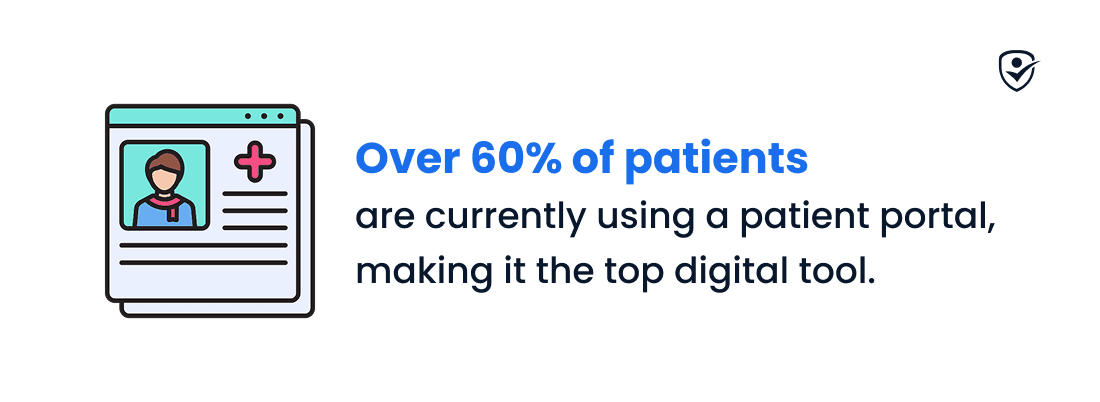
5 Common Reasons Why Patient Portal Adoption Fails
Patient portals often fail to deliver value, reducing patient satisfaction, staff productivity, and overall care coordination. Below are the five most common reasons patient portal adoption fails.
Low patient adoption
Low patient adoption is one of the biggest reasons patient portals fail to deliver value. When there is poor onboarding, and the benefits are not communicated effectively patients don’t find a valid reason to use that platform.
A 65-year-old diabetic patient at a mid-sized family practice might register after a visit. But its a high change they might abandon the portal when unable to locate A1C report in the portal.
As a result, many patients fail to return to their portal after first login. It impacts engagement and care coordination.
Poor user experience
Poor interface is another reason behind low usage of patient portals. Many portals have complex interfaces and not user-friendly. Navigation becomes difficult for mobile users rsulting in poor user experience.
Additionally, patients with limited digital literacy, including older adults, may struggle to sign in or find information, reducing consistent portal usage.
Delayed responses
When a patient sends a message through the portal and doesn’t hear back for longer than 3 days, they lose confidence in the channel.
After similar experiences, they return to calling the front desk. This increases the administrative burden for in-house clinical staff and further reduces portal effectiveness. Hospitals need to work on delayed responses and communication gaps to increase engagement.
Administrative overload on staff
A poorly maintained patient portal can increase the staff workload rather than reducing it. When patients do not use portals due to their complex interface or lack of IT knowledge, staff start managing the portal tasks manually and receive unlimited patient calls. It increases the workload on the front desk workers.
Disconnected systems and data issues
One major challenge to patient portal adoption is poor system integration. When the portal does not sync properly with the EHR, scheduling, and billing systems, patients may see outdated or missing information.
Delayed lab results and incorrect appointment availability create confusion and reduce trust in the platform. These issues often come from broader EHR interoperability issues, which affect data accuracy and workflow continuity, making patients less likely to adopt and consistently use the portal.
To address this challenge, healthcare practices must focus on improving onboarding, usability and workflow integration.
How Hospitals Improve Patient Portal Usage Without Changing the Software
To improve patient portal adoption does not mean you need new portals but also adopt a better approach to manage the existing ones.
Simple patient onboarding for first-time users
Most patients drop off before they even start due to a lack of guidance about using the portal. It can have a direct impact on the administrative department. Their workload increases as phone calls and messages from patients increase when the user is not aware of using the portal.
When onboarding is skipped or rushed, patients often enter incorrect information or miss key steps which contributes to healthcare documentation errors that staff then have to correct manually.
The best way to improve patient portal engagement is to make onboarding as simple as possible. Give proper instructions to patients on how to use the patient portal. Many healthcare practices are also working with virtual medical assistants to fix patient portal usage.
Assistants handle onboarding calls and guide first-time portal users to enhance patient engagement. When onboarding is simple, patients are far more likely to return and use the portal regularly.
Offer online self-scheduling to drive repeat logins
Patient scheduling is one of the important portal features and a strong engagement driver. Especially if the platform is easy to use, patients prefer to book online appointments because it is convenient. Providing an online self-scheduling opportunity can give a solid reason for patients to log in, improving patient engagements with the portal.
Front-desk support can better manage call volume along with administrative workload, and also give patients access to book an appointment at any time.
Use automated reminders for patients
Patients often forget appointments or follow-ups in a traditional setting. Manual call reminders are time-consuming but automated appointment reminders can reduce no-show rates by up to 30%.
Hospitals can send SMS reminders or email alerts through patient portals, one of the most effective engagement tools and it also allows patients to reschedule appointments.
Uploading test results on the portal and informing patients through sms or set automated reminders gives them a reason to login the portal for prompt follow-up with their doctor. Automation improves attendance rates and keeps patients consistently engaged without manual efforts.
Set a 24-hour response rule for portal messages
Heavily-layered responses are one of the biggest reasons patients abandon portals. Patient satisfaction levels decrease, and they prefer to choose somewhere else to get their treatment. To resolve these issues, hospitals can set a time to respond within 24 hours.
It assures patients that they can get a response within a specific time period. Faster responses build trust and encourage patients to rely on a portal for increasing engagement.
Educate patients on what portal is used for
Many patients don’t use portals simply because they don’t understand its need.
At this stage, it is important to highlight benefits of using patient portal adoption such as quick access to test results, and scheduling online appointments instantly. Communication is easier and faster online without having the need to leave their home.
When patients see comfort with minimum disruption in their routine, it creates value by using these portals, increasing their engagement.
Optimize portal for mobile users
The majority of the patients use mobile phones to access digital tools. If your portal format is not mobile-friendly, opening takes time and has no zoom-in option, it needs to be optimized.
To make your patient portal mobile-friendly, you need to check the core design and functionality of the portal on different devices including:
- Navigation
- Text size
- Zoom-in options
- Layout of the app
- Security (2FA)
- Accessibility etc.
Additionally, make sure the portal has an appealing color palette and easy-to-understand language. Make sure you provide a translation option in the portal to increase patient portal engagement.
Assign ownership of portal management
Most of the portals underperform because of lack of ownership leading to patient’s incomplete records, when not updating timely.
To address this, healthcare facilities can assign a dedicated professional to manage messages and upload reports.
Practices actively managing high patient volumes often rely on virtual medical administrative support to handle portal tasks without pulling in-house staff away from patient care. They see a higher patient engagement, faster response times reducing front-desk load.
Conclusion: Turning Patient Portals into Operational Assets
Patient portal fail because of lack of operational ownership. Across several hospitals and privacte practices pattern is the same: patients register, log in once, and return to front-desk. Messages remain unanswered, reported are uploaded late, and appointment scheduling still happens on a call. Clinical staff end up doing portal work manually.
Assigning clear responsibility for patient portal onboarding, message response time and report uploads improves portal usage. Patients begin to trust the system. Staff experience reduced calls and communication becomes faster.
Many healthcare organizationsthat succe3ss with patient portal and engagemnent treat them as part of their operational process. In such cases, hospitals rely on support from remote healthcare staffing companies to provide dedicated support staff to handle routine portal tasks and maintain timely communication.
With the right support and processes, patient portals become more effective in improving engagement, reducing administrative burden, and supporting better patient care.

