


The Federal No Surprises Act was implemented on January 1, 2022. The NY surprise billing law took effect in 2015. So, for providers, it is sometimes difficult knowing which rule should be applied where.
Your team needs to know when surprise billing protection is applied. How to bill patients correctly. They also need to know when balance billing is prohibited. What to do in case of a payment dispute. Even a small step missed can lead to delayed reimbursements, patient disputes, or regulatory action.
In this guide, we will walk you through New York’s surprise billing requirements for 2026. We will also cover where they differ from Federal Law, and the practical steps healthcare practices can take to stay compliant while protecting revenue.
What Is NY Surprise Billing Law?
The New York Surprise Billing Law is a set of state protections that protect patients from unexpected medical bills in some out-of-network situations. It also sets the rules for how providers and health plans can handle payment when a surprise billing case occurs.
The NY Surprise Billing was passed in 2014 and became effective in 2015. It was the first law to protect patients from surprise medical bills. In covered situations, patients cannot be charged more than their in-network cost-sharing amount.
Does the Federal No Surprises Act Replace NY Surprise Billing Law
No. NY Surprise Billing Law came first and was enacted in 2015, while the Federal No Surprise Act was enacted in 2022. Both laws remain in force, and NY providers may need to comply with one or both depending on the patient’s health plan, type of service, and the billing situation.
New York’s Law is more restrictive in some areas. For example, if a patient chooses an in-network hospital and an out-of-network provider treats him without his consent. The provider cannot ask the patient to sign a form agreeing to pay the extra bill.
These types of matters are solved between the provider and insurer through New York’s independent dispute resolution (IDR) process. It helps patients avoid unexpected bills.
The Federal No Surprises Act protects patients in some situations where NY does not. For example, it includes air ambulance and some out-of-network services such as imaging, laboratory tests, and care provided before and after a procedure.
In these covered situations, patients generally pay their in-network cost-sharing amount instead of receiving large bills. Ground ambulances are still not covered under either law.
Since both laws apply, the provider should decide which rules apply based on the patient’s insurance and the medical service provided. They also need to know the circumstances of the case.
The 4 Situations That Trigger Surprise Bill Protections
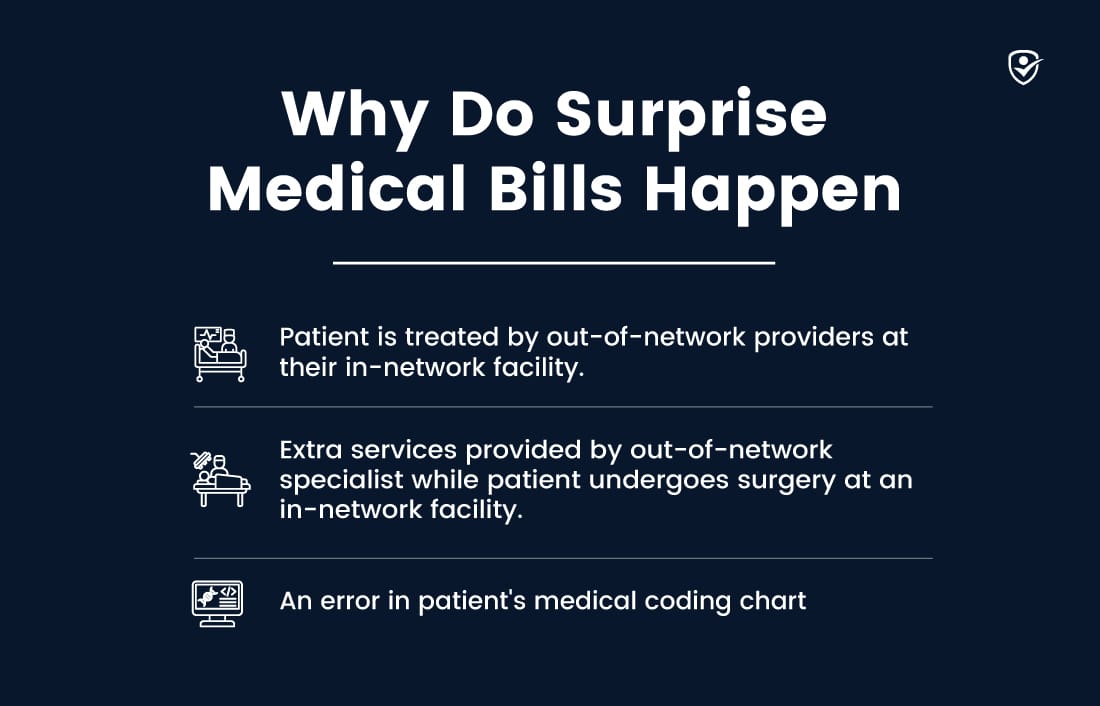
Not every out-of-network service is qualified as a surprise bill. New York law and the Federal No Surprise Act protect patients from surprise bills under 4 situations.
Emergency services at an in-network ER or freestanding ED
If a patient receives emergency care at an in-network hospital or freestanding emergency department, they are saved from surprise bills. In such cases, the patient only pays in-network costs while the provider takes an additional amount from the insurance plan.
Non-emergency services from OON provider at in-network facility
If you provide emergency care at an in-network hospital as an out-of-network provider, this is where service protections laws are usually applied. In many cases, you cannot charge the patient more than their in-network cost-sharing amount.
OON provider referral without patient consent
You need to be aware that as a provider referring a patient to an out-of-network provider without getting written consent may result in a surprise bill. So, make sure to get the written consent from the patient before referring him to an out-of-network hospital or provider. You cannot obtain this permission later.
Air ambulance from OON provider
Services such as an air ambulance by an out-of-network provider fall under the Federal No Surprise Act. So, keep in mind that you cannot bill more than the in-network cost-sharing amount. And you can get an amount based on federal standards.
NY Surprise Bill Compliance Checklist for Healthcare Providers
Before your next patient walks in, make sure your practice has these five things in place.
Required disclosure notices
Your healthcare practice must display a one-page notice in plain language on the patient registration form. You can also include it in your admission areas on your website. This is the requirement of New York law. And this notice should completely brief patients on how to report Federal and New York law in case of any violation. In case this notification is missing, this is a compliance violation, no matter if your bill is accurate.
Consent documentation for elective OON referrals
If you call a doctor from an out-of-network practice, get written consent from the patient for non-emergency care. Do not rely on verbal consent; this is not considered. If it is missing, it can turn a routine referral into a surprising bill.
To stay compliant and avoid disputes, healthcare practices flag out-of-network providers before a referral goes out. This gives the team time to collect written consent before the appointment, not after.
Good faith cost estimates for uninsured/self-pay patients
If you are retaining a patient who has no insurance and will pay himself, give the patient an expected bill before treatment. If the bill is $400 or more, the patient can dispute the charges within 120 days.
Verify insurance and OON status before appointment
A provider who was in-network doesn’t mean it will always be in-network. He can be out-of-network before any appointment. It is your responsibility to check about provider status before assigning them cases at your healthcare practice. Skipping this step is one of the most common reasons a routine visit turns into a surprise billing situation.
Healthcare practices work with virtual medical insurance assistants to confirm provider network status before each appointment. It reduces the risk of an unintended out-of-network situation before it reaches the patient.
Claims submission timelines under NY law
There are specific deadlines NY law sets to submit claims after a service is rendered. If you miss those deadlines, it can cause claim denials. In some cases, you may not even have the right to appeal.
To avoid these losses, many healthcare practices also get support from virtual medical billers. They maintain disclosures and documents to submit claims within the given time framework.
How to Resolve a Surprise Bill Dispute in New York
If a patient disputes the bill, do not try to collect the amount when the case is in progress. Work with the patient’s insurance company to resolve the payment concerns.
If you, the provider, or the insurance company do not end up on an agreement, either party can start the independent Dispute Resolution (IDR).
Keep in mind that which IDR process you can choose depends entirely on the insurance plan of the patient. For example, New York’s state IDR process is applied to fully insured and state-regulated health plans.
While the Federal IDR process is applied to plans outside state authority, like self-funded employer plans.
If you get a NY DFS surprise bill certification form from a patient or health plan, you need to respond within the given time. If you miss the deadline, it can put your reimbursement at risk.
What Happens If Your Practice is Non-Compliant
If your healthcare practice doesn’t follow NY surprise billing law, it can face more severe consequences than a single compliance issue.
Fines and audit exposure under NY DFS
If you don’t follow NY billing law, it can cost you $ 2,000 to $ 5,000 under state law and $ 10,000 under federal law. If this issue affects multiple patients, penalty amounts increase, which can be a major risk factor for your healthcare practice. Because DFS counts violations per patient, not per provider.
Patient complaint pathways
Patients usually do not warn a practice before lodging a complaint. They directly complain about any suspected violation to the New York Department of Financial Services or the Attorney General’s Health Care Bureau. This is what triggers an investigation at your practice.
Claim Denials and revenue impact
Non-compliance doesn’t just increase risk of a fine. Beyond fines, a missed disclosure or billing mistake can cause claim denials; delayed payments can lead to billing disputes. It can even trigger broader review of your practice’s billing process. To stay up to date regarding every document, there should be virtual medical administrative assistants responsible for managing them.
Healthcare practices avoid hefty fines and keep disclosure notices and consent forms up to date.
Conclusion
Most NY healthcare practices don’t lose revenue because they ignored the rules. They lose it because someone on the team was already handling three other things when the disclosure form needed to go out.
A missed notice. A late claim. A consent form collected after the fact. Each one is a fixable mistake until it becomes a DFS violation or a denied claim.
This is where practices that work with virtual patient care coordinators have an edge. The compliance tasks that get deprioritized during a busy day- insurance verification, OON status checks, consent documentation, claims deadlines- get handled without pulling clinical staff away from patients.
A remote staffing company provides that support. Which is why healthcare practices use Remote Scouts to stay on top of NY surprise billing requirements without adding to their in-house workload. For practices looking to reduce compliance risk without expanding their internal team, it is a practical starting point.


