

When the last patient leaves, your other job starts: payroll, claim appeals, the stack of resumes waiting to be reviewed. For most owner-dentists, this is the second shift. Time management is a serious systems problem, and it comes with a price.
The main issue is the cost of the tasks you handle yourself. If your operator can make $500 an hour, and you waste an hour on admin, it costs you around $25 to $35 in admin support. You make a huge dent in the value of that time.
These eight dental office management tips are designed to help increase the chair time, save you from reviewing numbers yourself, survive cancellations, and provide a simple but effective way to handle administrative work that should be left to the clinical team.
Start With the Numbers That Actually Run the Practice
If you are wondering how to manage a dental office without getting buried in reports. lost in too much report work. start with three key numbers. Production that tells you how much work was done. Collections tell you how much money arrived. Overhead tells you how much of that money is already spoken for.
Production, collections, and the gap between them
Production shows the work you have performed and billed. Collections show the amount of cash you have to run your practice. The difference is made up of insurance write-offs, adjustments, unpaid patient balances, and claims still waiting on a payer. Your practice may have recorded production but come up short on payroll if the money has not been collected yet.
Overhead as a percentage, not a feeling
Your overhead ratio is your total operating expenses divided by collections. General dental practices often spend 60%-65% of their collections on overhead, according to the ADA.
Before comparing your overhead to an industry benchmark, make sure your calculation includes the same expense categories the benchmark uses.
Once you know your practice’s overhead rate, you can estimate how much of your collections goes toward operating costs. It also shows where you can start reducing operating costs without cutting care quality.
Overhead also creates operating leverage when a practice has mostly fixed costs. Operating leverage means if you have high fixed costs, a small increase in revenue can lead to a bigger increase in profit. However, a loss in revenue can also hurt your company. When collections decline, some expenses, such as rent, salaries, and debt payments, may stay the same.
In this case, if a practice brings in $1 million and has 62% overhead, about $380,000 would be left. With a reduction of 10% in the collections and no reduction in costs, the profit drops to approximately $280,000. Therefore, if the owner collects 10% less, they might lose a much greater percentage of their earnings.
Setting a monthly review rhythm the owner will actually keep
On the first business day of every month, spend 20 minutes to review three reports:
Production by provider: If production decreases for one provider, determine its reasons. It can be fewer appointments, low-value procedures, or unused appointment chair time.
Collections compared with production: If collections are behind, there is still more money uncollected, and this can impact the cash flow of the practice.
Accounts receivable: As the 90-day AR continues to rise, it could indicate that there is less cash available for future expenses and payroll.
Build a Schedule That Protects Production
A first-come, first-served schedule can fill prime hours with low-value, time-consuming appointments. Instead, reserve prime time for longer or high-value procedures and use shorter appointments to fill open gaps.
Block scheduling around high-value procedures
Block scheduling is to preserve time slots for high-value procedures in advance, so low-value tasks do not take this time. Those complex and high-value procedures are crowns, bridges, and surgeries.
Handling same-day cancellations and no-shows
Build a short-notice list of patients who have already accepted the treatment procedures and can come within two hours if an appointment becomes available. Your front desk should contact patients on short notice when a slot opens to turn an empty operation into same-day production.
Many dental practice owners take a 10% broken-appointment rate as a normal part of running their business. Track cancellations by day, provider, and appointment type for one quarter.
By day, check for weekly patterns. If Mondays and Fridays have more cancellations, your patients might be experiencing weekend brainstorming or extending their trips.
By provider, check if appointments are cancelled for a specific provider.
By appointment type, specifically look at procedures getting more cancelled.
Keeping the hygiene column full when staffing is thin
Restorative production may be affected by limited hygiene capacity, as exams and diagnoses of new treatments occur during hygiene visits. If the hygiene column is left blank today, the doctor’s column will likely be blank 6-8 weeks later.
It is challenging to find hygienists. The Bureau of Labor Statistics (BLS) estimates that hygienist jobs will increase by 7% between 2024 and 2034, making it more difficult for practices to fill open positions.
Build a contingency plan for hygienist staffing if no hygienist is available. An effective dental office management tip is to be flexible with the schedule, maintain a short list of patients who need hygiene care, and call them on short notice.
Run the Front Office Like the Revenue Function
Your front desk impacts revenue. This is where your marketing turns inquiries into leads or loses them.
Answering and converting new-patient calls
Call conversion is the ratio of new patient calls to booked appointments. The percentage of new-patient calls that end with a booked appointment. It can cost thousands of dollars to get the phone to ring with SEO, social media marketing, and local ads, but if the front desk can’t manage those calls effectively, then a lot of that money is wasted.
A lack of flexibility, a lack of individuality, and a lack of responsiveness to the patient’s needs can result in the potential patient leaving to call another practice.
Listen to ten recorded new-patient calls from the past week and score each based on three things: Did they offer two specific appointment times? Did staff ask for the patient’s name and contact number? Did they try to book the appointment before discussing the price?.
Check-in, check-out, and collecting at the time of service
Verify the patient’s expected portion prior to treatment based on insurance verification completed 48 hours in advance. Take payment at checkout and discuss any balance owing before the patient leaves.
This saves time in chasing up unpaid accounts later and ensures the practice gets payment on time.
Documenting front-desk workflows so turnover does not reset the practice
Many practices have front desk knowledge that is undocumented simply because someone who has been doing the same job for years is expected to know everything. If they leave you, your practice has to begin all over.
Create single-page workflows for each regular task like new patient calls, insurance follow-up, check-out, collection, etc., or end-of-day close. The replacement or temporary hire is up to task within weeks, not months.
The majority of the tasks do not require a building. The desk receives calls for new patients, verifies benefit eligibility, calls back for recalls, and submits claims; these are all activities that are easily done remotely. A dedicated dental administrative assistant working remotely can take care of these tasks and give your team extra support without hiring another employee in your practice.
Take Control of Insurance Verification, Claims, and Denials
When payment delays are caused by insurance verification issues, it can create unnecessary stress for your staff members and delay payments. Establish a standard approach for claims, denials, and insurance verification to ensure prompt payment to your practice.
Verifying benefits before the patient sits down
Benefit verification is a procedure where practices verify a patient’s dental insurance coverage prior to treatment. The front desk checks eligibility, frequency limitations, waiting periods, missing-tooth clauses, whether the policy is active on the date of service, the remaining annual maximum, and deductible status.
The maximum amount for a dental surgery is typically $1,000 to $2,000. The limits have remained nearly constant over the last few decades despite rising costs of dental treatment. Anything above this cap becomes the patient’s responsibility.
Submitting clean claims with the right attachments
Compile all necessary documents before claim submissions, including narrative, periodontal charts, and X-rays. Claims that are completed correctly, with the proper documentation, have a lower denial risk.
It provides the insurance provider with the information required to process the claim, minimizing delays in payments and the number of claims that are returned for lack of information.
Also have a record of procedures that may be downgraded by your patient’s insurance. A downgrade is when a covered procedure is paid at the cost of a less expensive procedure.
Keep a proper record of procedures. Each insurance plan may downgrade, so your team can explain and collect the patient’s share instead of absorbing the difference.
Working denials and aging AR on a fixed schedule
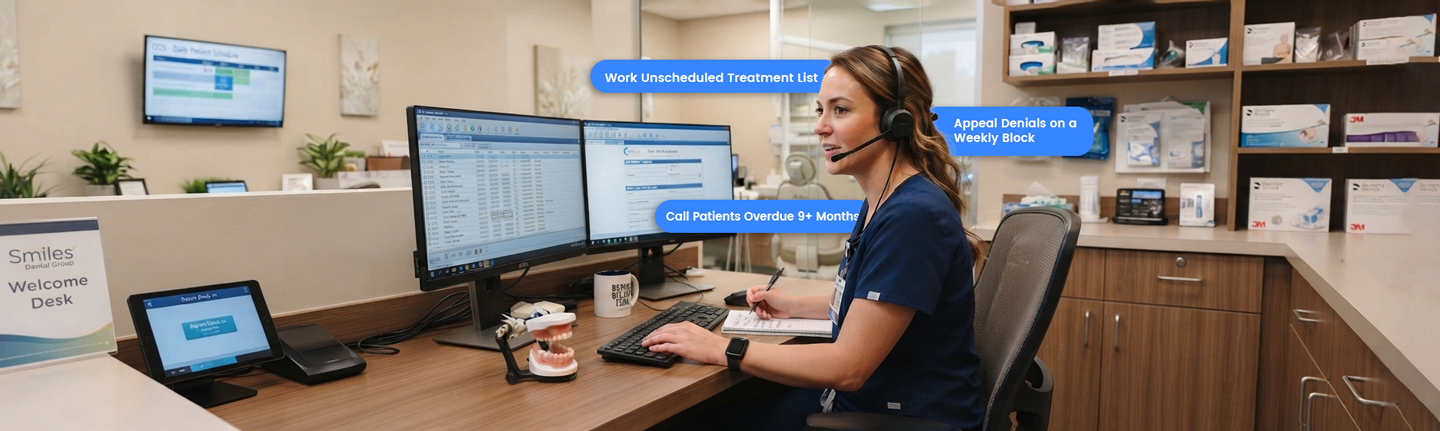
Some practices write off their dental insurance claims as they don’t have time to appeal them. Set some time to review old unpaid balances every week. Start with the oldest ones and follow up with the insurance company or patients, whoever is responsible.
Track received appeals separately every month to know how much money this work has brought back.
Have a record of the denial reasons that show up most often and how to work them. Identifying denials helps your team identify issues and fix them before they get submitted.
Turn Recall and Unscheduled Treatment Into Booked Appointments
Start with patients who are overdue for hygiene or have recommended treatment but have not scheduled yet.
Auditing lapsed recall
Lapsed recall means patients who are overdue for their regular dental cleaning or checkup and have not booked or completed their appointment.
Create a list of every patient overdue by more than nine months for a regular cleaning, sort it by last production value, and call the top 100 patients.
Many of the patients may not have switched to another dentist but drifted. A dental practice may quietly lose 20% to 30% of its active patients over a few years.
You may not notice this until you see the monthly report because losing patients doesn’t seem like a big deal when you are not fully focused on it.
Working the unscheduled treatment report
Unscheduled treatment is diagnosed and presented, but the patient never schedules it. Crowns, fillings, bridges, or root canals all sit on this list. In many practices, no one is assigned to work the list.
Assign one team member to review the list and contact patients each week and contact patients with specific appointment options. Assigning follow-up work to someone who owns the revenue cycle is what turns the report from a list into scheduled appointments.
Presenting and following up on accepted-but-unbooked plans
An accepted but unbooked treatment means your patients didn’t get an appointment. If the patient says, “Let me think about it, do not assume the procedure is the only concern. Keep the fees and treatment queries separate.
Book a follow-up date before a patient leaves. A planned follow-up is more effective than simply waiting for a patient to call your practice.
Hire, Define, and Keep the Team the Practice Depends On
An ADA Health Policy Institute report shows 90.8% of dentists find recruiting dental hygienists extremely or very challenging.
Managing a dental office has become difficult as clinical roles are taking longer to fill than they used to. With time, staffing challenges in the broader context of hiring for specialized healthcare roles.
Writing role clarity before posting the job
When every team member knows what their responsibilities and documented properly it helps it makes managing the front desk at the dental office easier. Writing clear roles that states task ownerhsips, also prevents one person from constantly picking up tasks that belong to someone else.
Having no boundaries means orphaned tasks keep landing on that one capable team member. Repetition eads to burnout and resignation.
Onboarding through the first 90 days
Be specific in your onboarding methods. Without having a clear plan, new employees spend months guessing instead of performing.
A 30-60-90 day onboarding plan works as a clear pathway for new employees who know the level of performance their practice wants from them.
Day 30: At this stage, a front-office hire at your dental practice should completely own insurance verification and check patient benefits accurately before their arrival.
Day 60: By day 60, your employees should own checkout and collections, handling patient payments and scheduling follow-up visits.
Day 90: By day 90, they should have their own hygiene recall list. They should be able to independently call overdue patients to keep the practice schedule full.
This plan in written form gives a clear picture of a new hire’s progress at your practice.
Pay, feedback, and the reasons people actually leave
Many practice rely on their senior employees.
Instead of ignoring mistakes of a long-term employee, practice owners should create a feedback loop. Conduct monthly one-on-one meetings with employees to know their progress.
Do not try to correct an employee’s mistake in the middle of a stressful and chaotic day. Wait until you’re calm, have enough evidence to prove it, and then talk to them in a private space in your practice.
Try to know the core reason when someone resigns. Ask them some questions to know the possible reason for leaving. Is it a pay problem? Are wages not enough compared to other practices? Is it management or leadership driving people out?
Uncovering the answers tells you what to fix before you introduce the next hire into the same team environment.
Decide Which Administrative Work Should Leave the Clinical Team
Protecting capacity in a busy practice depends on separating work that requires the operator from work that only requires a desk.
Separating chairside work from desk work
Task separation means dividing office responsibilities between work that requires chairside presence and tasks that can be handled at a desk.
Location-dependent clinical work: It involves assisting the dentist, sterilization, and seating patients that require a physical presence in the operatory.
Location-independent administrative work: Insurance verification, claim submission, insurance denial follow-up, statement follow-up, and recall calling are all location-independent administrative tasks.
Assistants will lose focus during clinical emergencies and when there is an immediate need to attend to a patient. Administrative tasks take the back seat and cause a significant backlog or billing mistakes and slow down your cash flow.
Costing an administrative hour against a production hour
Many practice owners make a direct financial comparison to discover the actual cost of hiring.
Calculate the hourly production income of your dental practice. Now track how many clinical hours per week you and your clinical staff aren’t on paperwork, insurance verification, and billing calls.
Multiply your admin hours by your hourly production rate, and your staff’s admin hours by their hourly wage. Add the two, multiply by your working weeks per year. Compare that figure with what dedicated support would cost
Choosing between in-house, cross-trained, and offsite support
Another common dental office management mistake is fixing an administrative backlog by cross-training a dental assistant to cover the front desk work at lunch.
Assign each task one owner from the in-house team, and set aside uninterrupted time for paperwork.
If you decide to outsource administrative work hours, understand how offsite support costs compare with an in-house hire first. They can help you assess whether offsite support makes financial sense for your practice.
A signed Business Associate Agreement (BAA) and document access controls for who can view patient records. Make sure the offsite team works in your working hours for clear communication. The service must have a written SOP for the work you have transferred and what you expect from a third party.
Put Compliance and Written Systems on a Recurring Calendar
Maintain regulatory compliance, including OSHA, HIPAA, and infection control. This figure shows why cyber preparedness and compliance are important for your practice.
OSHA, HIPAA, and infection control documentation
A HIPAA security risk analysis is a required written review of where you store patient health information (PHI) and what can put it at risk.
This includes hackers, accidental loss, device failure, disasters, and other threats to the confidentiality, integrity, or availability of PHI.
HIPAA isn’t the only policy requirement dental practices need to consider. State health data privacy rules that reach past HIPAA may also apply, depending on where the practice operates and how it handles patient information.
Do not rely on memory to meet federal OSHA safety guidelines and infection control rules. Simply assign specific tasks to your team members so everyone knows their work and when to do it.
Let your dental assistant test the sterilization machine (autoclave) weekly and document the results. This shows the machine is killing the germs and protecting patients from cross-contamination.
Ask your office manager to conduct a live test restore of your data backups. Do not trust your backup just because the software shows a green signal. Most dental offices only know about the breakdown of their backup at the time they need it badly. When a backup is blank, it means you have lost patient history, billing records, and schedules.
Add calendar reminders for mandatory bloodborne pathogen training and BAA reviews. This helps the practice follow OSHA safety rules and keep your staff safe from dirty needles and fluid exposure.
An SOP library the team maintains rather than the owner
A common bottleneck occurs when the owner dentist writes SOPs alone. Keep every procedure up-to-date and maintain the SOP library.
Have a separate folder for clinical operations and front desk work. Share common cloud applications like Google Drive or Microsoft Teams that can be edited by everyone. Don’t depend totally on printed binders or PDFs that people don’t open.
Turn on edit history so everyone can know about the changes when anyone on your staff makes them.
Make updates as part of your daily routine. If a staff member finds a faster way to process an insurance record, update the SOP the same day and save the revised version in the shared folder. Also keep your guides short and visual so everyone can understand.
As a dental owner, you are still required to read and approve all clinical and safety guides such as sterilization steps or emergency drug checks.
Moving from Burned-Out Boss to Empowered Owner
Managing a dental practice becomes easier when a practice does not rely solely on the dental owner to handle everything. Clear financial reviews, well-organized scheduling, and follow-ups give a clear direction to follow the system more carefully.
Start by identifying the areas that take more time or tasks that create more problems. Fix that process, document the new workflow, and then move to the next one. If staffing is taking too much of your time, a remote staffing company for legal practices can help you provide support with administrative and back-office tasks.
Most Frequently Asked Questions
How much should I be paying a dental office manager, and should any of it be a bonus?
The salary range in the country is from $26 to $40 per hour ($55,000 to $85,000) per year, largely based on the size of your practice and whether the manager is doing the collections. If you do offer a bonus, you should not make it based only on the total amount collected. Managers may choose to ignore legitimate charges to meet the targets.
What is the most common software used in dental offices?
Dentrix is one of the most commonly used dental practice management software. Other options that are most of the time used are Eaglesoft, Open Dental, and Curve Dental.
How many patients should one front-desk person realistically handle?
One full-time coordinator has the ability to manage up to two full-time providers or 15 to 18 appointments per day. When your phone rings regularly and goes to voicemail, insurance is being checked in the morning, the patient has to wait, and the patient recall list is pending for weeks. It means your practice capacity has been exceeded.
What do I do when my practice management software is old, and everyone hates it, but migrating feels too risky?
The true switching challenges are actually data conversion glitches, staff reluctance, and training downtime. To reduce the risk, have a vendor conduct a test with a copy of your data. Double-check that all patients’ charts and balances are totally accurate. And ensure that your data can be exported easily at any time in a universal format.
How do I actually take a vacation without the practice of losing money that week?
A closed week is bad because the overheads are still being incurred, e.g., salaries and rent, but the production income is not being generated. You can correct this by setting up additional hours before the week you are leaving on vacation and after the week you are leaving on vacation. Allow the hygienist to do their job; don’t let your dentist miss out on the baseline revenue!

