
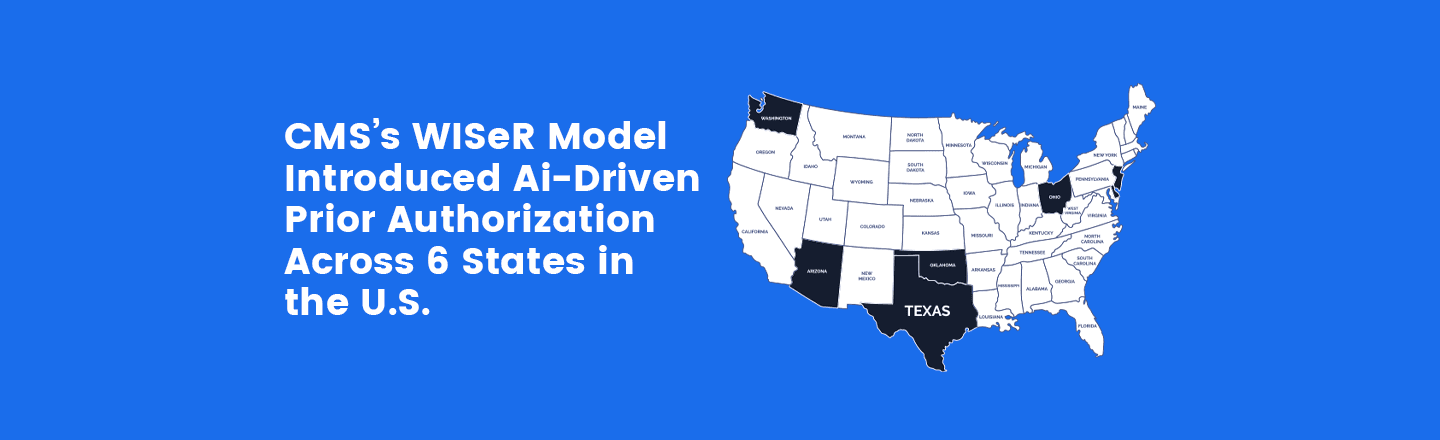

If your health system operates in Arizona, New Jersey, Ohio, Oklahoma, Texas, or Washington, your prior authorization workflows changed fundamentally on January 1, 2026. Chances are, your staffing model is far behind and hasn’t caught up yet.
That’s the real story behind CMS’s Wasteful and Inappropriate Service Reduction (WISeR) Model. It might sound like a congressional drama. There are legitimate policy debates about AI in Medicare. However, healthcare executives, operations, and revenue cycle management (RCM) present a more urgent concern: who in your organization is managing the new submission queues, tracking denials, preparing peer-to-peer reviews, and chasing follow-ups with AI vendors?
Because right now, work is either falling on your clinical staff or isn’t getting done at all.
What Is the CMS WISeR Model?
The Wasteful and Inappropriate Service Reduction (WISeR) Model is a CMS Innovation Center (CMMI) pilot program. For the first time in its history, Traditional Medicare introduced AI-assisted prior authorization through the model.
Launched on January 1, 2026, and running through 2031, WISeR currently operates across six states: Arizona, New Jersey, Ohio, Oklahoma, Texas, and Washington. The model covers four Medicare Administrative Contractor jurisdictions and targets a defined set of outpatient services that are considered high risk for fraud, waste, and abuse.
CMS frames the WISeR Model as a fraud-prevention tool across all 6 states.
Why the WISeR Model Is Drawing National Attention
Waste in healthcare harms patients but also contributes up to 25% of healthcare spending in the U.S. Low-value services eliminate clinical effectiveness, and the WISeR Model helps reduce unsupported care. The CMS Model works with companies experienced in using enhanced technologies and improves the review process for a pre-selected set of services that might be vulnerable to fraud or waste.
However, risks are coming forward too, as pointed out by the Washington Post’s investigation, that patients and providers are experiencing weeks and months-long delays. Some say its technology “ glitches”. Some say its inappropriate denials under the WISeR Model.
Physicians in all six states report that procedure approval rates under WISeR are running lower than under Medicare Advantage. The program, Traditional Medicare, was specifically chosen to avoid because of its prior authorization burden.
Less than 5 months into the pilot, in Washington state, approval timelines that previously ran two weeks have now stretched to four to eight weeks.
In Ohio, challenges are more severe, and physicians are considering dropping specific procedures because the AI vendor’s review process is producing outcomes that fall outside coverage guidelines. As per the investigation, the WISeR portal didn’t even work in Ohio until very recently.
In Arizona, physicians reported spending more than an hour on the phone trying to get a peer-to-peer conversation to resolve a denial or to share more information. However, there was a week-long delay before the conversation took place.
This leaves patients and providers without any option but to wait for necessary care.
In the House Ways and Means Committee hearing in May 2026, Rep Suzan DelBene (DWA) confronted HHS Secretary RFK Jr. directly. It was stated that the care denials “exploded” under these six states without an explanation to patients or healthcare providers.
In response, DelBene and colleagues initiated the SMARTER Care Act. It is a legislation that repeals WISeR entirely. So, it remains in the committee.
How AI-Driven Claims Processing Created the WISeR Problem
Prior authorization has always been a friction point impacting clinical decisions to meet payer requirements. AI has become more of a common intersection, and WISeR is one major example of this shift.
Commercial payers and CMS Innovation Center programs are busy deploying machine learning (ML) to automate pre-service review, analyze clinical documentation, and match it against coverage criteria. They generate approval or denial recommendations before a human clinician manually reviews the case.
AI processes have an operational appeal, where a high volume of standardized requests can be processed faster and at a lower cost than manual review teams.
However, automation works best when documentation is clean, services are neatly coded, and coverage criteria remain unambiguous following clinical facts. It breaks down exactly where clinical judgement is most important for complex cases, patients with comorbidities and procedures that sit at the standard coverage criteria. In those cases, an AI model optimized for rule matching produces denials that a physician review would not.
In response, you will see denial management platforms evolving, too. Health systems are now investing in tools to track denial patterns, flag at-risk claims before submissions, and automate appeal workflows.
But these tools also require clean data pipelines, trained assistants to operate them, and integration with the EHR systems. This is the kind of infrastructure that mid-size health systems are currently focusing on while managing claims volume.
Similarly, the healthcare revenue cycle is becoming more automated and demanding as a result of the WISeR Model. A new layer of AI-assisted review added by payers or CMS requires a layer of human expertise to navigate it. Healthcare organizations understand that this dynamic and staff usage will cause less disruption than relying on technology alone.
The Biggest Risks of AI-Driven Claim Denials
WISeR makes these risks concrete, but they apply to any AI-driven claims review program.
Algorithm bias: AI models are trained on the historical claims data. It inherits the patterns in the data, including patterns of under- or over-authorization for specific procedures, demographics, or geographies. The training data produces biased outputs at scale without a human reviewer catching any individual case.
Lack of clinical nuance: Standard cases have written coverage criteria. Physicians treat exceptions, so an AI model optimized for rule-matching will systematically deny cases where clinical judgment determines the outcome.
Explainability gaps: If a denial comes from an AI-assisted review, providers, at times, cannot determine the reason behind that decision. Without a clear reasoning, it is harder to plead an effective appeal.
Auditability risk: Health systems have no other way to identify systemic denial patterns or build a compliance record if vendors do not log or expose their decision logic.
Overreliance on automation: AI is most reliable when it handles the same volume and flags edge cases for human review. The burden of error correction increases when programs use it as a primary decision layer. It affects the providers.
The Pre-Existing Burden WISeR Is Making Worse
Before WISeR made a new single request, prior authorization used to be the most resource-intensive administrative process for healthcare operations.
The AMA’s 2024 physician survey found that the average practice processes 43 prior authorization requests per week. 95% of physicians said the process contributes to burnout. 35% employers onboard staff whose entire role is to manage authorizations.
The impact on the patient is direct and measurable. Delays in authorizations result in delays in care. Procedures like pain management or wound care are the specific categories that WISeR targets, but also cause delays that affect patients with chronic and ongoing needs. They cannot wait weeks to get approval for the process.
Appeal is another layer to compete when prior authorization is denied; the burden falls on the provider. Additional documentation, peer-to-peer review requests, resubmission, and follow-up do not guarantee clear timelines or outcomes.
WISeR adds to the burden instead of reducing it. Therefore, the health systems in the six pilot states are now managing traditional prior authorization workflows with a new AI-vendor review process. They are using different portals, different contacts, and different timelines for each state.
What Healthcare Organizations Should Watch Next
As mentioned earlier, the legislative outcome of the SMARTER Care Act will reshape the WISeR’s future. However, the timeline remains uncertain. Health system leaders must focus on monitoring several developments.
CMS plans to introduce a new gold-carding feature by mid-2026 to exempt providers with a consistent approval record from future prior authorization requirements under WISeR. Only those organizations will be considered to qualify that build a clean submission track record, such as accurate documentation, low appeal rates, or proper coding.
CMS also indicated that WISeR might expand to additional services, but it depends on whether early results support it.
Some healthcare organizations are expanding beyond their administrative support to a simple prior authorization workflow. They automate workflow, remotely coordinate with teams, while the healthcare virtual assistants reduce delays and improve documentation management.
What This Means for the Future of Healthcare Revenue Cycle Management
WISeR is represented as an AI-assisted review by the RCM for claims scrutiny. Denial management needs to be the predictive function where AI review anticipates which denials are most likely to occur and build appeal pipelines before they’re needed.
The payer-provider dynamic is also shifting with long-term implications for how revenue cycle teams are built. The healthcare organizations will have a competitive advantage as the AI-assisted reviews become the standard practice to eliminate friction at the point of submission.
Clean prior authorization requests must be accurate, complete and unambiguous and are less likely to trigger AI-generated denials. They are more likely to clear without appeals. It means that the revenue cycle function increasingly depends on the clinical documentation quality upstream.
Most Frequently Asked Questions
What is the WISeR Model?
The WISeR (Wasteful and Inappropriate Service Reduction) Model is a CMS Innovation Center pilot program that uses AI and machine learning to review prior authorization requests for select Medicare services before payment is approved. It launched January 1, 2026, in six states: Arizona, New Jersey, Ohio, Oklahoma, Texas, and Washington.
Which states are affected by WISeR?
The WISeR pilot currently operates in six states: Arizona, New Jersey, Ohio, Oklahoma, Texas, and Washington. The program runs through December 31, 2031, and CMS has indicated it may expand to additional states or service lines if results support it.
Can providers appeal WISeR denials?
Yes, providers can appeal WISeR denials, but the process is managed through private AI vendors rather than standard Medicare channels. The American Hospital Association has raised concerns about the lack of a clear patient-facing appeals process. Providers should document all submissions and vendor interactions from the first request forward to support any appeal.

